
TL;DR
- Zero trust is an architecture discipline, not a product. It eliminates implicit trust by verifying every access request based on identity, device, and context.
- The architecture is built on five interdependent pillars: Identity, Devices, Network, Applications, and Data. Weakness in one pillar compromises the entire model.
- Enforcement relies on a Policy Enforcement Point (PEP) and Policy Decision Point (PDP) that use a dynamic trust algorithm to evaluate each request against policy.
- Implementation is a multi-year program, not a project. It must be phased, starting with identity consolidation, followed by access segmentation (ZTNA), and finally, data-centric controls.
- Most implementations fail due to identity fragmentation, treating device trust as an afterthought, or accumulating "zero trust debt" by only securing a small subset of applications.
Most organizations claim to be adopting zero trust, yet breach reports consistently show that lateral movement remains a primary attack vector. This isn't a contradiction; it's a diagnosis. It reveals that while the label "zero trust" is everywhere, the architecture is often absent. I've seen this firsthand. During a post-breach review for a large financial services firm, we found they had deployed a ZTNA product but never built a functioning Policy Decision Point. Access decisions were still made by static firewall rules, meaning the "zero trust" label existed in the slide deck but not in the data plane.
This is the core misunderstanding that derails security programs: treating zero trust as a product to purchase rather than an architecture to build.
This guide corrects that. We will cover what zero trust security actually is, why the perimeter model it replaces is broken, and how the architecture works in practice. We will explain the five foundational pillars, the enforcement mechanics defined by NIST, and a realistic phased approach to implementation. Most importantly, we will examine the common failure modes that derail most programs before they deliver real value.
What Zero Trust Actually Means (and What It Does Not)
Zero trust is a security architecture model in which no user, device, or network location is granted implicit trust. Instead, every access request is evaluated based on identity, device posture, and other contextual signals before access is granted on a least-privilege basis.
Let's clarify what this does not mean. Zero trust is not about trusting nothing or blocking everything. It's about eliminating the dangerous assumption that anything inside the traditional network perimeter is safe. The core operating principle, "never trust, always verify," means shifting from location-based trust to continuous, context-based trust.
This concept, which originated with John Kindervag at Forrester in 2010, has been formalized into a concrete architecture by standards bodies like NIST in its Special Publication 800-207 and reinforced by frameworks like the CISA Zero Trust Maturity Model. The real architectural shift is from a one-time, location-based decision ("you are on the corporate network, therefore you are trusted") to a dynamic, per-request evaluation ("you are who you say you are, your device is healthy, and this request is consistent with policy for this specific resource at this moment "). It's an architecture pattern with specific components, not a marketing label for a single product.
Why Perimeter Security Fails in Cloud and AI Environments
Consider a common attack pattern: a user's VPN credentials are stolen in a phishing campaign. Because the VPN grants broad network-level access, the attacker can now move laterally from a low-value endpoint to a file share containing regulated customer data. This often happens without triggering a single alert, because east-west traffic inside the perimeter is implicitly trusted. This isn't a hypothetical; it's the anatomy of countless enterprise breaches.
This happens because perimeter-based security is built on an assumption that has collapsed: that everything inside the network boundary is trustworthy. This was already a fragile model when users and applications lived in a single data center. It is architecturally incompatible with how modern enterprises operate.
Today, workloads run across multiple cloud providers. Users connect from personal devices over untrusted home networks. SaaS applications are accessed directly from the browser, and AI tools like generative AI copilots process sensitive data far outside any corporate perimeter. The "perimeter" is gone.
The specific architectural failures are clear:
- No east-west traffic inspection: Once inside, attackers can move freely.
- No per-request evaluation: Trust is granted at the session level, not for each action.
- No device posture assessment: Access is granted without verifying the health of the connecting device.
- No data-level controls: The focus is on controlling the network door, not what walks out of it.
The perimeter model doesn't just have gaps. Its core assumption of a trusted internal network is fundamentally broken, necessitating the implicit trust elimination that zero trust provides.
The Five Pillars of Zero Trust Architecture
Zero trust is not a single control but a system of interdependent pillars that must work together. Weakness in any one pillar creates a critical vulnerability that undermines the entire model. The CISA Zero Trust Maturity Model formalizes these pillars, providing a roadmap for agencies and enterprises alike.
Identity: The Foundation of Every Access Decision
Identity is the most critical pillar because every other control depends on reliably answering the question: "Who is requesting access?" In a zero trust model, this means more than a username and password. It requires strong multi-factor authentication (MFA), tight integration with a central identity provider (IdP) like Microsoft Entra ID or Okta, and the ability to trigger step-up authentication when risk signals change. Identity must also extend to non-human entities like service accounts, API keys, and AI agents.
This is where many programs stall. Identity fragmentation across multiple IdPs and disconnected policy engines is a massive operational drag. Consolidating enforcement into a cloud-native SSE and SASE architecture, the approach Netskope has built its platform around, reduces that friction and makes the trust algorithm auditable from a single control plane. If you cannot reliably identify every user and entity, every subsequent control is built on sand.
Devices: Posture Assessment Before Access
The second pillar answers: "What is requesting access?" Device posture assessment verifying OS patch level, endpoint protection status, disk encryption, and certificate validity must happen at the moment of access, not just once during enrollment. Effective zero trust architectures calculate a dynamic device trust score that informs what level of access a device receives.
This pillar is arguably the most underinvested in enterprise security. Many organizations rigorously verify user identity but then grant access from devices they have never inspected, creating a massive blind spot. A key architectural principle is that device trust is not a binary (managed vs. unmanaged) but a continuous variable. The absence of a posture signal should degrade the trust score and limit access, not be ignored.
Network: Microsegmentation and East-West Control
The network pillar addresses lateral movement. Microsegmentation is the practice of dividing a network into small, isolated zones to ensure that a compromise in one segment cannot spread to others. This is what makes the "assume breach" principle operational.
It's important to distinguish between legacy network segmentation (using VLANs and firewalls) and modern user-to-application segmentation enforced by a trust broker. While microsegmentation is a network-layer control that restricts lateral movement, zero trust is a broader access architecture. Deploying microsegmentation without a functioning policy engine that evaluates identity and context does not constitute zero trust. It simply creates smaller, isolated perimeters.
Applications and Workloads: Per-Request Evaluation
In a zero trust architecture, access is evaluated at the application level, not the network level. Each request to any resource a SaaS tool, a private app in a data center, or an AI workload in the cloud is independently authorized based on user identity, device posture, and data context.
This introduces the concept of session-level granularity. Access is not a simple on/off switch. A trust decision can restrict specific activities (e.g., allow viewing but block downloading), trigger step-up authentication for a sensitive action, or revoke access entirely if behavior becomes anomalous mid-session. This per-request evaluation is what truly separates zero trust from traditional, session-based access control.
Read more: The Most Critical CASB Use Cases in the Market Today: Enforce Conditional, Activity-level Policies
Data: The Asset Zero Trust Ultimately Protects
Data is the pillar that gives the entire architecture its purpose. Every other control identity, device, network, and application exists to protect data from unauthorized access and exfiltration.
Data-centric security means classifying data by sensitivity, applying data loss prevention (DLP) policies that travel with the data wherever it goes, and enforcing controls based on the content itself. This is critical for preventing sensitive information from being pasted into generative AI prompts or uploaded to unsanctioned cloud storage. Without a strong data pillar, a zero trust architecture controls who can enter a room but not what they can walk out with.
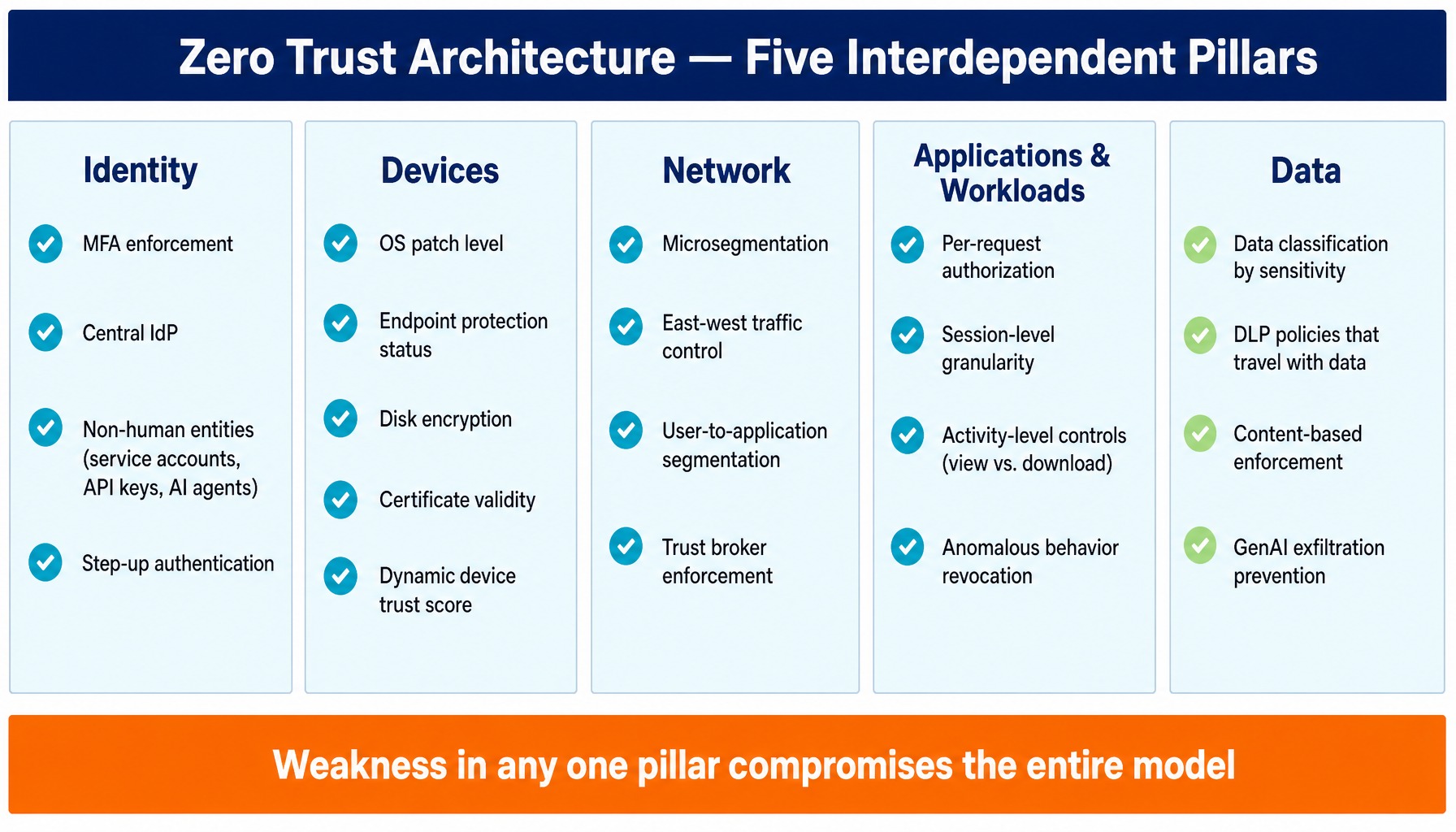
Zero trust architecture depends on five interdependent pillars working together.
How Zero Trust Architecture Works: PEP, PDP, and the Trust Algorithm
Understanding zero trust conceptually is one thing; understanding how it works architecturally is another. NIST SP 800-207 defines a specific enforcement model with three core components: the Policy Enforcement Point (PEP) , the Policy Decision Point (PDP) , and the trust algorithm that connects them.
Let's walk through a single access request:
- A user on a managed laptop attempts to access a private application hosted in AWS.
- The request is intercepted by a PEP . This is the component in the data plane that enforces policy. In modern architectures, this is often an identity-aware proxy or a ZTNA connector. The PEP does not forward any traffic until it receives a decision.
- The PEP gathers the request context user identity, device posture signals, location, time of day, and the requested resource and sends it to the PDP on the control plane.
- The PDP, which is the central policy engine, evaluates this context using a trust algorithm . This is not a static set of rules. As most practitioners will tell you, it's a dynamic function that weighs multiple signals: identity confidence from the IdP, the device trust score, behavioral analytics, the data sensitivity of the requested resource, and real-time threat intelligence.
-
The PDP returns a decision to the PEP:
allow,deny, orrequire step-up authentication. - The PEP enforces the decision in the data plane, either granting access to the application or blocking the request.
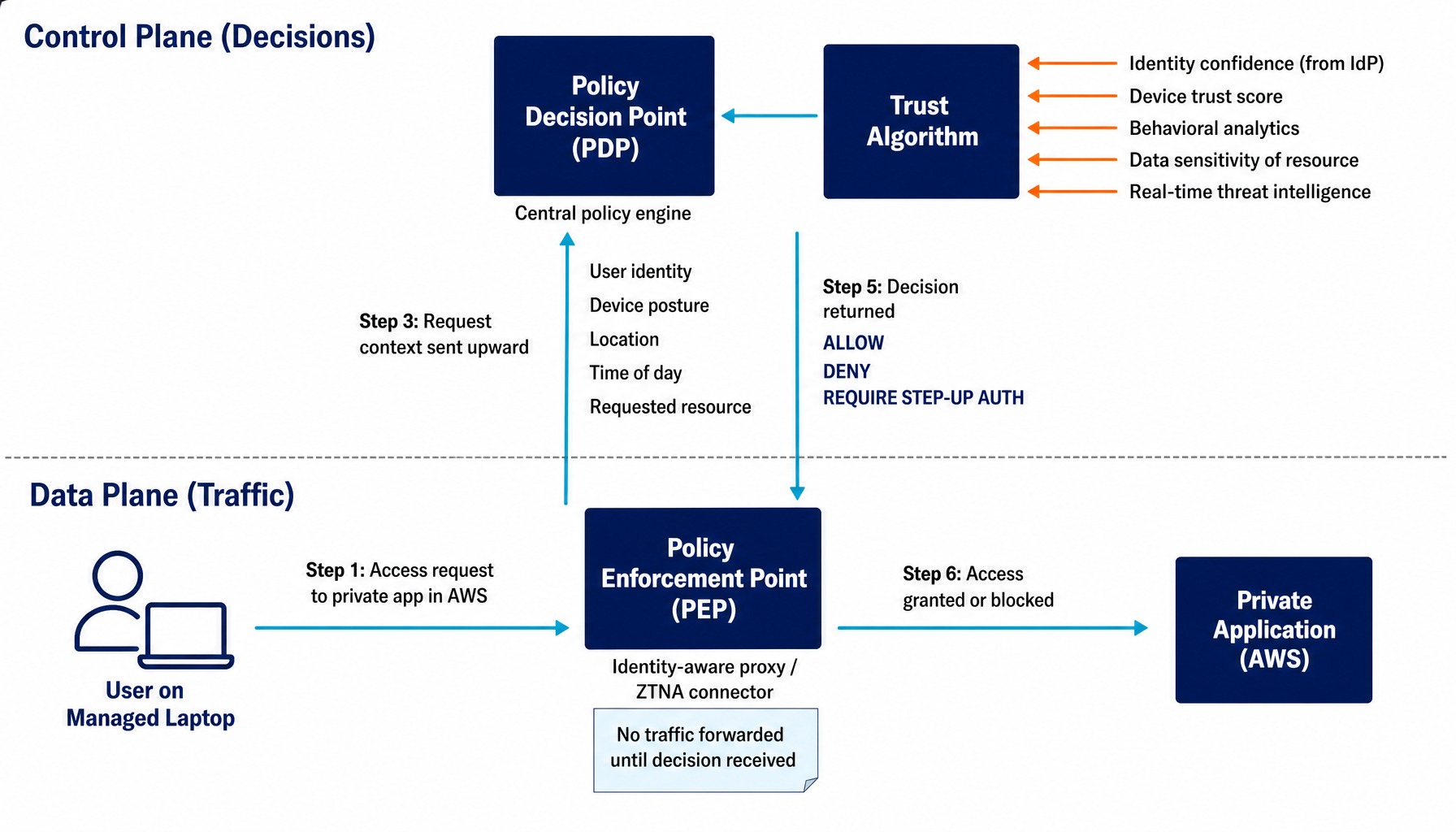
How zero trust architecture works: PEP, PDP, and the trust algorithm per request.
This separation of the control plane (where decisions are made) and the data plane (where traffic flows) is what makes zero trust resilient and scalable. This per-request evaluation model is architecturally distinct from a traditional firewall, which makes coarse-grained decisions based on IP addresses and ports, not on the rich context of identity and device posture.
ZTNA vs VPN: Why Network Access Had to Change
The architectural problem with a traditional VPN is simple: it authenticates a user once and then places them on the network , granting broad access and implicit trust. Zero Trust Network Access (ZTNA) authenticates the user for each application and never places them on the network.
Consider two employees, one using a VPN and one using ZTNA, whose credentials are both compromised.
- The VPN user's attacker gains access to an entire network segment. They can scan for vulnerable hosts, discover file shares, and move laterally to higher-value targets.
- The ZTNA user's attacker gains access to exactly one application. They have no network visibility, no ability to discover other resources, and are subject to session-level controls that can detect anomalous behavior and revoke access.
ZTNA operates on the principle of a software-defined perimeter (SDP), which makes internal applications invisible and inaccessible to anyone who has not first been authenticated and explicitly authorized. This creates a "dark cloud" where attackers cannot find what they cannot see. The trust models are fundamentally different: a VPN authenticates once and trusts the network; ZTNA authenticates per request and trusts nothing. For enterprises looking to secure a distributed workforce, ZTNA from providers like Netskope also eliminates the performance penalty of backhauling all traffic through a central data center.
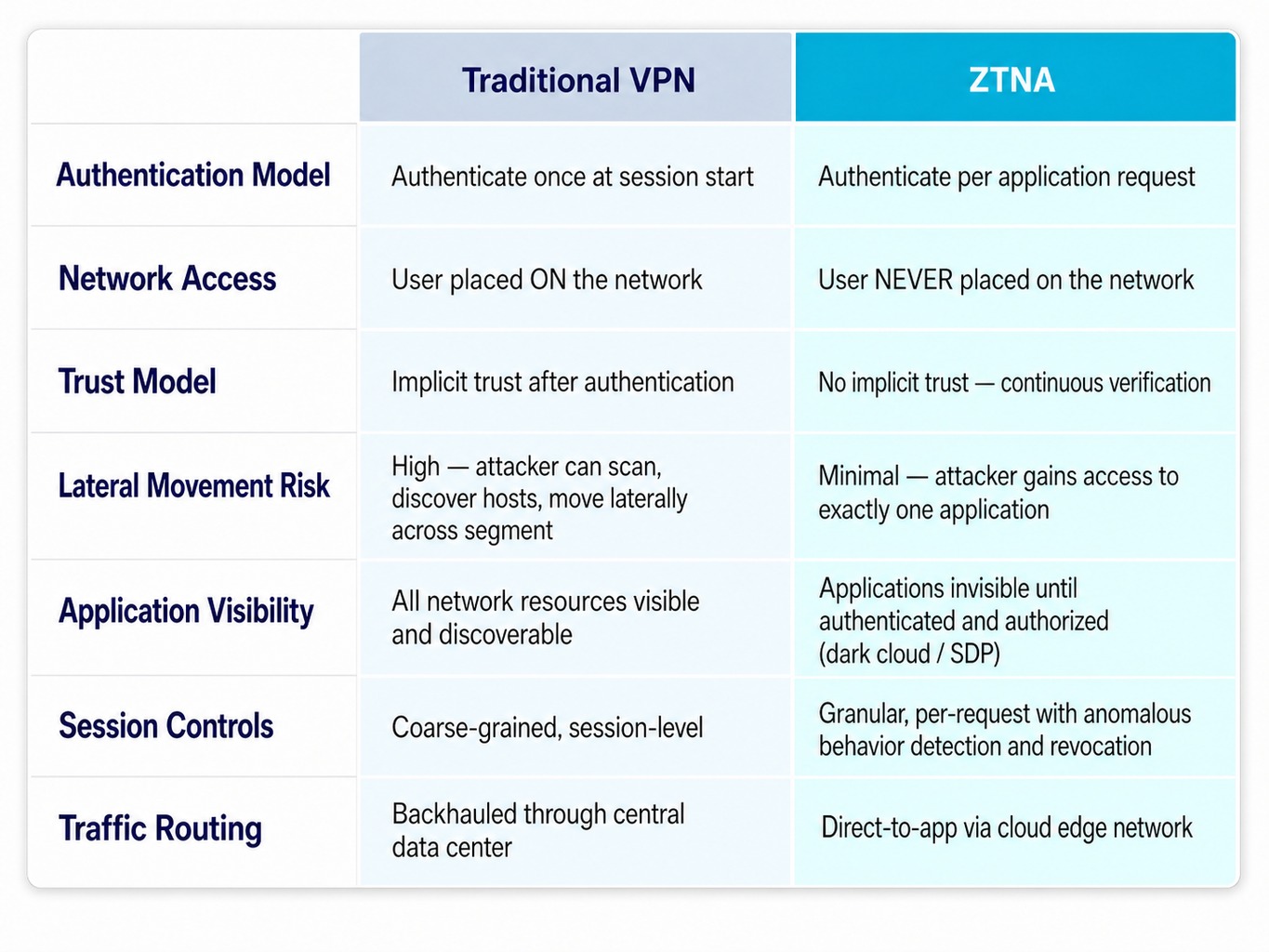
ZTNA vs VPN: why zero trust network access replaces implicit network trust.
How to Implement Zero Trust: A Realistic Phased Approach
Zero trust implementation is not a 90-day project. For most enterprises, it is a multi-year architecture transformation that must be phased to avoid business disruption and demonstrate incremental value. The biggest mistake is trying to implement all five pillars simultaneously without first consolidating identity. The CISA Zero Trust Maturity Model's progression from Traditional to Advanced to Optimal provides a useful benchmark for this journey.
Phase 1: Consolidate Identity and Establish Device Trust
The first and most critical phase is consolidating all user populations employees, contractors, partners into a single, authoritative identity provider with MFA enforced universally. Without a single source of truth for identity, the PDP cannot make reliable trust decisions. Simultaneously, you must establish a baseline for device trust by implementing posture assessment for managed devices and defining a clear policy for unmanaged device access. If you cannot reliably identify who is requesting access and from what kind of device, every subsequent security control is built on a foundation of sand.
Read more: The Most Critical CASB Use Cases in the Market Today: Detect and Alert on User Login Anomalies
Phase 2: Segment Access and Replace VPN with ZTNA
Once identity is consolidated, you can begin replacing legacy VPNs with ZTNA for private application access and enforcing application-level segmentation for SaaS and IaaS workloads. This is the phase where the PEP/PDP architecture becomes operationally real, with access decisions made per request based on identity and device context. This is also where most organizations discover a significant amount of shadow IT business-critical cloud applications being used without security team awareness and must begin applying conditional access policies to govern their use, often with an inline CASB .
Phase 3: Extend Data-Centric Controls and Continuous Monitoring
The final phase extends zero trust to its ultimate objective: protecting data. This involves deploying unified DLP policies that follow data across cloud, web, SaaS, and private app environments; classifying sensitive data; and building a continuous monitoring program that feeds behavioral analytics back into the trust algorithm. In 2026, this phase must also address the secure use of AI, such as preventing sensitive PII or intellectual property from being pasted into public generative AI prompts. This is where zero trust evolves from a static deployment into a living, adaptive security program.
Where Zero Trust Implementations Fail
Adopting the zero trust label is far easier than building the architecture. Practitioners encounter several failure patterns repeatedly.
- Identity Fragmentation: The organization deploys a ZTNA solution but still has three separate identity providers with inconsistent MFA policies and user directories. The PDP receives conflicting or incomplete identity signals, making it impossible to render a reliable trust decision. The architecture diagram looks correct, but the identity foundation is fractured.
- Zero Trust Debt: A team implements zero trust for a few low-risk applications, declares victory, and moves on. The majority of sensitive workloads remain on legacy access models. Over time, the gap between the small "zero trust" zone and the actual enterprise attack surface widens, creating a false sense of security.
- Device Trust as an Afterthought: The organization invests heavily in identity verification but grants access from devices it has never inspected. This is the most common and dangerous blind spot. Verifying a user with MFA only to grant them access from a compromised, unpatched personal device negates the entire principle of continuous verification.
How Netskope Operationalizes Zero Trust Across Cloud, Web, and AI
The central tension of zero trust is that it requires converged, context-aware enforcement across all five pillars. Stitching together point products for ZTNA, SWG, CASB, and DLP inevitably leads to the fragmentation, policy gaps, and device trust blind spots that cause implementations to fail.
The architectural answer is a unified SASE platform that consolidates these functions into a single policy engine and enforcement framework. The Netskope One platform is built on this principle.
The Netskope Zero Trust Engine acts as the converged PDP, evaluating user identity, device posture, application risk, and data sensitivity on every request across cloud, web, private apps, and AI. Our ZTNA capabilities replace legacy VPNs with granular, per-application access delivered over the high-performance Netskope NewEdge network. This isn't just about security; with capabilities like a 50 ms round-trip for TLS inspection , we ensure that security controls don't degrade the user experience. Crucially, our unified DLP and AI security services extend data-centric controls everywhere data moves, preventing sensitive information from being pasted into genAI tools or exfiltrated through unsanctioned cloud apps .
By converging security and networking into a single, cloud-native platform, Netskope One provides the architectural foundation to avoid fragmentation and build a zero trust program that is effective, scalable, and auditable.
See how Netskope One delivers zero trust across cloud, web, and AI
From Label to Architecture
Zero trust is not a product you buy or a checkbox you complete. It is an architecture discipline that demands a fundamental shift away from location-based trust toward continuous, context-aware verification. This transformation requires converged enforcement across identity, devices, networks, applications, and data, all orchestrated by a PEP/PDP model that evaluates every access request.
As AI workloads, autonomous agents, and multi-cloud environments continue to dissolve what remains of the traditional perimeter, the need for this architectural rigor will only intensify. The organizations that have invested in genuine zero trust not just the branding will be the ones that can innovate securely and with confidence.
Frequently Asked Questions (FAQ)
Does zero trust eliminate the need for firewalls?
No. Zero trust changes what firewalls do, not whether they exist. Firewalls still provide essential network-level segmentation and block unauthorized ingress traffic. In a zero trust architecture, they operate alongside identity-aware proxies and other PEPs rather than serving as the primary trust boundary, becoming one enforcement layer among several.
How does zero trust handle IoT and unmanaged devices?
Since IoT and unmanaged devices often cannot run endpoint agents or complete MFA, zero trust isolates them into microsegmented network zones with tightly scoped access policies. The PDP evaluates device type, behavioral baselines, and network context to determine what each device can reach, enforcing least-privilege access without relying solely on identity.
What is the relationship between SASE and zero trust architecture?
SASE (Secure Access Service Edge) is a delivery model that converges networking and security services including ZTNA, SWG, CASB, and FWaaS into a single cloud-native platform. Zero trust is the security architecture that SASE enforces. A SASE platform provides the integrated PEP and PDP infrastructure that makes zero trust operationally possible at scale.
Can small businesses implement zero trust or is it only for enterprises?
The principles apply at any scale. Small businesses can achieve significant risk reduction by starting with cloud-delivered ZTNA to replace VPNs and consolidating identity with a single IdP to enforce MFA universally. They do not need to build a full PEP/PDP architecture from scratch; cloud-native platforms deliver that as a service.
How do you measure zero trust maturity in an organization?
The CISA Zero Trust Maturity Model offers a structured framework with three levels Traditional, Advanced, and Optimal across all five pillars. Organizations use it to assess their current state, identify where implicit trust still exists, and map a path to continuous verification. Maturity measurement is increasingly tied to cyber insurance underwriting and regulatory audits.